

Three things I noticed in Anthropic’s S-1, and what I’m watching next

Anthropic filed its S-1 on Monday, and the market has already shifted around it. The first read was good. Bloomberg described the filing as calming nerves, with investors pointing to a broad, less concentrated customer base and $131.7B of cash at the end of June, and the Nasdaq 100 bounced 1.1% after two straight weeks of declines.
Then Alphabet reported on Wednesday night. The stock fell about 12% on Thursday, its biggest post-earnings drop on record, on slower search growth and heavy AI spending, and the AI names sold off again. Amazon followed on Thursday night. AWS grew 39%, its fastest in nearly five years, but the stock fell about 6% after hours as trailing free cash flow turned into a $42B outflow on $77B of quarterly capex.
While we wait for Q3 numbers in the amended filing and see how the roadshow goes, a few things in the S-1 stood out to me.
1. Most of the compute bill isn’t spent serving customers
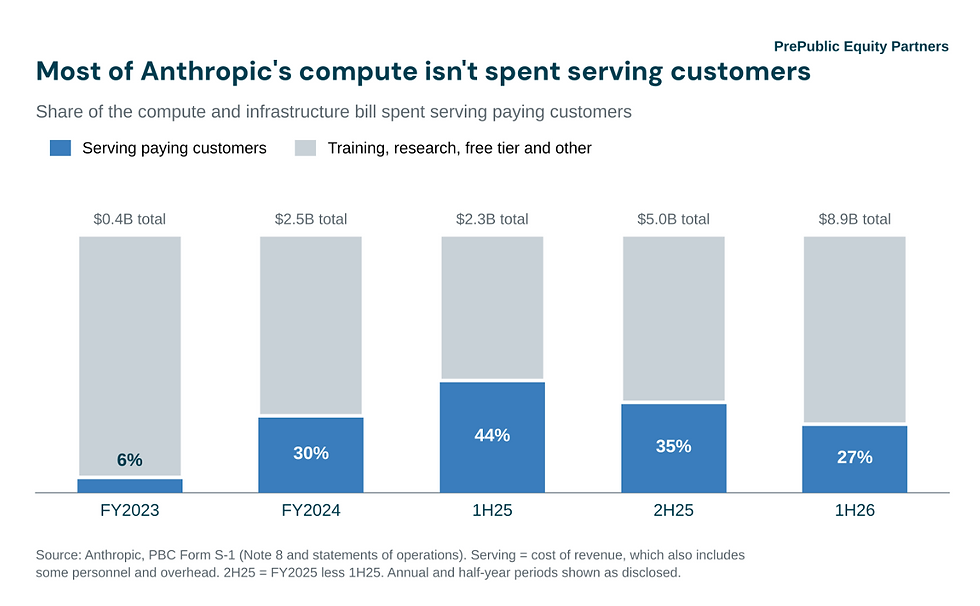
Note 8 breaks out operating expenses by function, which turns out to be more useful than the headline P&L. Cost of revenue, which the company says is substantially all compute for customer-serving workloads, was about 44% of the total compute bill in the first half of 2025 and about 27% in the first half of 2026. So roughly three-quarters of Anthropic’s compute now goes to training, research and the free tier.
On my math, gross margin on the serving side went from about 12% to about 85% over that year, and revenue per dollar of serving compute went from 1.1x to 6.8x. Some of that is revenue catching up to capacity bought 12 to 18 months in advance, so I wouldn’t extrapolate too much, but the serving economics look very good.
The bigger question is what the other three-quarters is worth. If better models keep earning more per unit of compute, the training spend looks like an investment. If it’s just what it costs to stay at the frontier, it’s closer to a permanent operating cost. The filing has some support for the first view: models released in the six months to September drove over 80% of Q3 revenue, and Anthropic says Opus 5.5 cut customers’ cost per task by about 40% versus Opus 5. MBI Deep Dives frames this well as race, choice or flywheel.
2. A broader customer base, with the hyperscalers on every side of it
Customers spending $100K+ a year went from about 1,500 at the end of 2025 to more than 11,900 at September 30. Revenue from outside the top five customers rose from 64% in Q1 to 79% in Q3. For scale, that’s more $100K+ customers than Datadog and Cloudflare have combined, and Anthropic added roughly 10,900 of them in a year, some 10x the ~1,000 seen in Cloudflare’s best year on record. The filing also estimates that 5–7% of revenue in the first nine months came from customers later found to be breaking its usage terms, so some of that count may not stick, worth watching.
At the same time, 48% of first-half revenue came through cloud marketplaces, and Anthropic has committed at least $114.5B to Google Cloud alone. The big clouds sell Anthropic its compute and resell its models, and Amazon and Google are also large investors, so I’d read their results this week partly as Anthropic data points.


3. Anthropic is underwriting a lot of other people’s buildouts
As of June 30, the filing shows $265.6B of fixed or minimum compute purchase commitments plus $321.4B of leases that haven’t started yet, and several more deals were signed after that. Those contracts are what the providers on the other side borrow against. Bloomberg reported this week that Anthropic accounted for more than a third of SpaceX’s Q3 revenue, making it SpaceX’s largest single customer. Elon Musk said over the weekend that debt markets have almost entirely shut off for companies without substantial revenue outside AI data centers. A couple of the GPU-provider contracts in the S-1 are conditional on the provider lining up its own financing or facility lease, so Anthropic’s demand forecast ends up sitting inside other companies’ credit stories.

What I’m watching now
The amended S-1. The price range, Q3 revenue and Run-Rate Revenue are all still blank.
How public investors treat the training spend. Alphabet’s reaction suggests there isn’t much patience right now for spending without a visible return, and that will matter for the multiple Anthropic gets.
Neocloud financing. Whether the smaller GPU providers can raise the debt (and equity) behind their Anthropic contracts.
The secondary market. How pricing for other late-stage AI companies moves once there’s a public comp, and what happens to secondary volume after the listing.
Disclosure: Funds managed by PrePublic Equity Partners have indirect economic exposure to Anthropic, PBC through interests in special purpose vehicles, and may increase, reduce or exit that exposure at any time without notice. This post draws on Anthropic’s preliminary Form S-1, filed with the SEC on October 26, 2026 and not yet effective, and on the news coverage linked above. Figures and charts are my own calculations from those sources. Views are my own as of the date of publication.
Care to get more insights and access to our research? Fill out the form below.
RESEARCH DISCLOSURE This article is for informational and educational purposes only. It represents independent thematic analysis prepared by PrePublic Equity Partners ("PEP") and is intended to discuss industry trends and company dynamics in the private markets. This content does not constitute investment advice, a recommendation, or a solicitation to buy or sell any security or investment product. PEP is not a registered investment adviser or broker-dealer. Any offer or solicitation relating to securities will be made only through definitive offering documents to eligible investors. PEP and its affiliates may hold financial interests in companies discussed herein and reserve the right to trade such positions at any time without notice. Private market investing involves significant risk, including illiquidity and potential loss of principal. All data is sourced from publicly available information and has not been independently verified.
IMPORTANT DISCLOSURE This content is published by PrePublic Equity Partners, LLC (“PEP”) for informational and educational purposes only. It reflects independent research and the author’s views on industry trends and company developments in the private markets as of the date of publication. Those views may change without notice, and PEP has no obligation to update this content.
Nothing in this content is investment, financial, legal or tax advice, or a recommendation to buy, sell or hold any security. It is not an offer to sell or a solicitation of an offer to buy any security, including interests in any fund or vehicle managed by PEP. Any such offer will be made only through a confidential private placement memorandum or other definitive offering documents, and only to investors who meet the applicable eligibility requirements.
PEP is an exempt reporting adviser and is not registered as an investment adviser with the SEC or any state, or as a broker-dealer.
PEP, its funds and affiliates, and their officers and employees may hold financial interests in companies discussed in this content and may buy or sell those interests at any time without notice. Where funds managed by PEP have exposure to a company that is a main subject of a post, the post says so. PEP does not receive compensation from any company it writes about.
Information in this content comes from public sources that PEP believes to be reliable, but PEP has not independently verified it and makes no representation as to its accuracy or completeness. Statements about future events are forward-looking and subject to risks and uncertainties, and actual results may differ materially. Prior observations and analysis are not indicative of future results.
Private market and pre-IPO investing involves a high degree of risk. That includes illiquidity, limited and unaudited information about private companies, and the potential loss of an entire investment.
PrePublic Equity Partners, LLC is an independently operated investment manager that is majority owned by AVG AM Holdings, LLC, an affiliate of Alumni Ventures. PEP makes its own investment decisions and operates independently of the Alumni Ventures investment platform.


Comments